New build, can't fix flickering

ESP-32D, WLED 0.15.1, driving 100x WS2811 pixels, powered by a 5v 4A power supply.

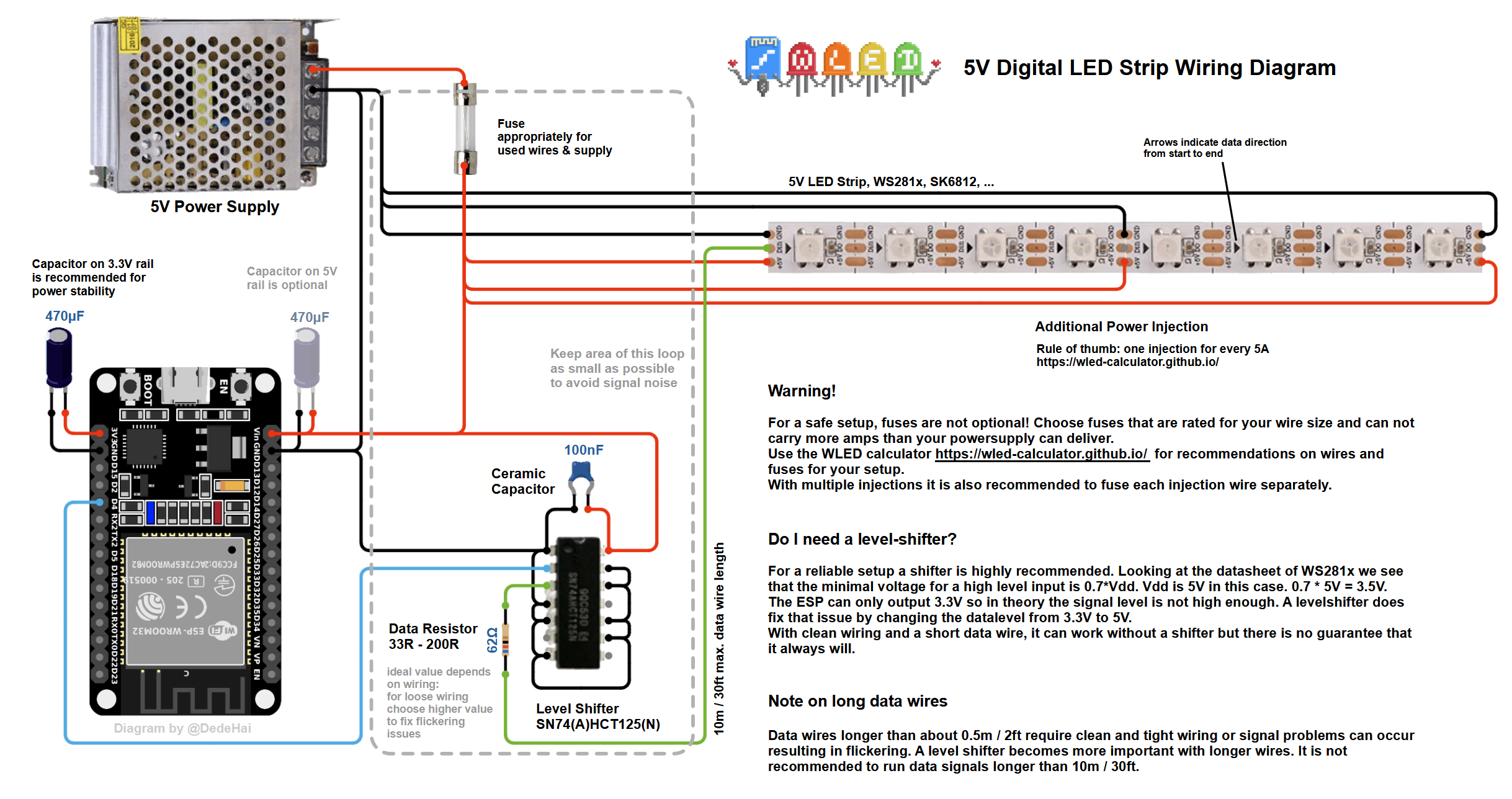
Wired *almost exaclty like this: https://kno.wled.ge/assets/images/content/WLED_5VdigitalWiring.png

Including fuse, capacitors, level shifter, and all, except I don’t have the 470uF capacitor connected on the 3.3v line yet, the resistor is 47ohm (don’t have a 62), and I’m not injecting in the middle, just at both ends.

Right now, it’s all breadboarded out (so there may be a poor connection somewhere).

Data line is a jumper wire to the SN74AHCT125N pin 2, then out from pin3 through a 47 ohm resistor to the first LED, complete data run is about 15cm max. Other inputs are grounded out. The final setup would have the data line be about half a meter.

Normally when on solid orange, it will flicker to green (which suggests to me that this is a bit flip or similar), though recently it’s started flickering to blue as well. It also happens on other patterns.

Video of flickering when commanded to “solid orange” to green/blue randomly, at random locations, for random lengths: https://ocimg.blackpacket.net/wled/20251103_104204.resize.mp4

I’ve tried a bunch of things, and the results are all muddled in my head now… things like changing the resistor value, leaving the level shifter out, lowering the refresh rate, etc. Nothing seemed to help.

Happy to try any suggestions..
The ideal value of the resistor is actually determined by the type of wire connected, but if you’re using those 3-wire LED cables like I see in that video, 47 ohms is very reasonable and probably better than 62. If its not working, probably you have something wired wrong. Got a picture of your level shifter?

first off, hard to say without seeing pictures but should be alright from the description
second, breadboards are notoriously unreliable
third: there is a bug in 15.1 that can cause flickering, see Since FW 0.15.1 an LED strip is flashing · Issue #4805 · wled/WLED · GitHub

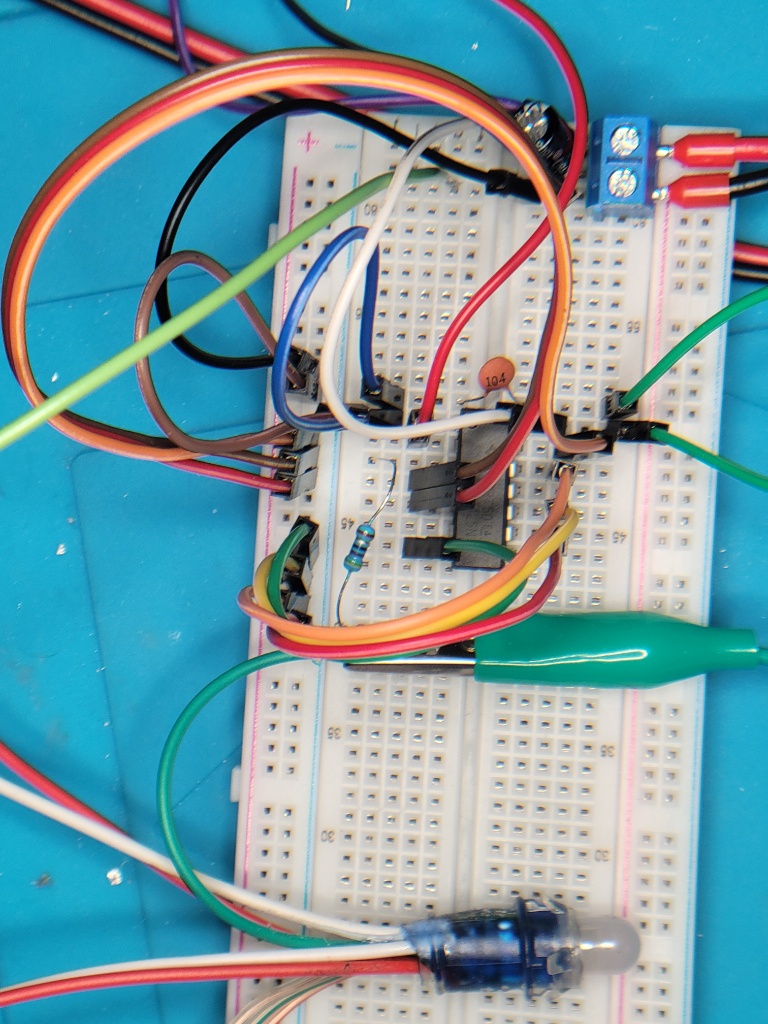
This is a bit messy, sorry. 5V Power comes in top right. There’s a 470uF cap there. +5V splits to purple (which goes to ESP VIN), and white, which goes to the top-right pin of the level shifter. GND splits to two blacks, one that goes to ESP GND and the other to the common GND on the left, which is then used to ground out all of the unused input pins.

Red coming in from the top is the ESP data pin, which goes to level shifter pin 2.

At the bottom is the first LED. I pulled the data line pin from the connector, the alligator-clip is holding it to the 47ohm resistor (and nothing else).

@dedehai This is definitely not the final setup. That bug looks promising… I’m going to try downgrading and see if that helps.

Downgrade to 0.15.0 has helped a lot. Still flickering though, just less often.

Issue is probably the ground wire from the level shifter. It should be in parallel with the green data wire. If you’ve connected it, you did so through such a long path it doesn’t even fit into frame, which is bad. It should go straight from the ground pin to the strip, can twist it around data to keep them paired. You’ve also installed the ceramic capacitor such that it won’t really work very well (it should go directly between pins 7 and 14 with the shortest possible wires).

Here’s a zoom-out. From the PSU (top right), the power splits and through a short cable, goes into the breadboard, which will be soldered beside the ESP and thrown into a project box once I get the flickering debugged. The second leg runs about a meter to another splitter, which goes to the beginning of the LED strip, and another meter of cable to the end of the LED strip.

I was originally testing this with the green 22-gauge cable connected to the beginning of the LED strip. For now, I’ve bypassed it to test. Do I need to have the green running in parallel (or twisted) even for a short distance to test?

I’ll try to move the ceramic closer.

I think you’d have to zoom out even further for me to actually see how many feet longer the ground cable is than the data cable :slight_smile: These are MHz circuits, your signal is in the gap between the data and ground wires, which is why you keep them together. You can split them up for a few inches without things getting too bad, but if your ground line is 1 m and your data line 4 cm, it is going to be heavily distorted and probably not work very well.
Looks to me like your lights have the ground wire that is supposed to be connected to the level shifter, but its taped over. Try connecting it and see if it works. Additionally, if you’re going to use loose wires like that, you may need a larger data resistor.

@saratoga Good news, I think moving the ceramic capacitor fixed it. Before, I had it sitting in the row above, with short patch cables linking it to the first row of the level shifter. I pulled that out, and now it’s connected directly in the first row of the level shifter. I’m going to monitor it a bit, but I think the distance between the ceramic and the level shifter was the problem.

The taped off wires are the extra power injection wires. Since I’m powering it using the JST 3-pin right beside it, I don’t need those. When I ran into flickering problems, I pulled the data wire out of the JST connector, to bypass everything and connect it as directly as possible.

Don’t suppose in the interest of science you’d be willing to introduce it again and see if the problem returns?

I am sure future us’es would appreciate knowing if it was a short/loose wire or actually the capacitor .

@jonathh4959 I like the way you think. Interestingly, I could not recreate the problem. I rewired it as it was before… no flickering. Even disconnected the capacitor, no flickering. Must have been a lose connection… somewhere… that got fixed when I moved the cap.

Thank you for exploring that for me.

Being a n00b I too am exploring a flickering problem, and am trying to appreciate the impact of - shall we say - less than ‘essential’ components on a very small scale set-ups.

@jonathh4959 Component-wise, I have a few 1-meter 60-LED WS2812 strips running problem-free for years… with no caps, no level shifter, no resistor. You can get away with a lot for short distances. (Though I did them on D1 Minis, which had (has?) a bunch of bugs that make Wifi a pain – use an ESP32 instead and save the hastle).

Interesting.

I have an esp 32 based setup driving 2 lengths of different types LEDs.. about 450 LEDs.

The distance to the first LEDs is metres.. but because I am using solid core old mains electric cable I believe I get away without a level shifter, resistors or capacitors. Not really keen to rock that boat as it works and has done for over a year now.

Recently created an esp c3 solution 2 channels soldered direct to it. Less than 30 centimeters (far less!) between the board and the LEDs…

It isn’t badly flickering but appreciably so. You can leave it on solid white and you’ll see random flickering here and there…

so it is interesting hearing you say about issues with the minis

I have some 0-1k pot resistors, capacitors and 2 types of level shifters on the way.. to see if they help. Probably ought to take it apart and put on a vero board to rule out any wiring issues too…

Some testing with only a resistor (most critical component) here: 3-wire Amazon addressable LED cable testing

Basically, if you pick the wire carefully and choose the right resistor value, you can do 10s of meters with good signal quality. But its tricky, you either need to use something like ethernet where you know the impedance exactly or else swap out resistors until you get it to work. The nice thing about a level shifter is that it gives you more headroom for bad wiring or a slightly off resistor.

1 Like

@jonathh4959 Here’s the problem I was having with D1 Minis: 14.1 can't connect to router on 14.1 on ESP8266 Wemos D1 mini · Issue #3690 · wled/WLED · GitHub Not my bug, but having the same issue.

@saratoga Thanks, that’s helpful.

1 Like

Just to close this topic: I soldered everything down, no flickering. The issue must have been a lose connection on the breadboard somewhere around the capacitor. While my data line will be less than a meter, I tested a 2m+ data line, with no flickering. Thanks for all the help!