I have some expirience with wled means i’m not a newby. But
For curiosity i bought a surplife 20x20 led curtain.
I want to exchange the controller to my normal esp32’s . I know these led’s that are imbeded in soft plasic on soft 3wire cables quite well.
But there are only 3 wires leaving the controller. The 20led chaines have the end open, no backwire from last DO….. And all chaines are connected fully paralell ,means also the 20 DI of the first led in chain is connected paralell .
Via their app (i do not want to use an app that collects/transfers whoknows data) i can in deed adress every single led.
Has anybody any idea how that is possible and how i can do this with wled.
P.S. Yes i know to use 2d and 3d in wled. And yes i understand the normal ws2812 adressing
Hi, it’s very likely that each line has a chip with a signal shifter like the one I attached in the image. It probably skips X LEDs (the length of the curtain), passes the signal straight down without shifting, and then shifts by X LEDs for the next line.
Have you tried connecting it to WLED? The only thing I can think of is that they might come programmed with a fixed address, but I don’t think that would make much sense from a production standpoint. I have some that come with a return wire; maybe the columns actually have 4 wires instead of 3?
Maybe it’s the first LED that has a 20-40-60 shifter…?
Have not yet tried with an esp32_wled. A shifter in the first led would not solve it.
The only way i can think of is either a posibility to program a diode to skip a certain amount of telegrams (you must do that before connecting to the main cable. What a logistic nightmare for this cheep matrix https://de.aliexpress.com/item/1005008253086888.html )
Or there is a unknown to me protocol for the ws that allows some adressing (do not believe as its 24bits cutting).
So i guess the only solution is that there exists a new variant of that type of leds that can additionaly uses adressing
I hope to find here someone who might know
P.S. I’m to stuppid to find a way to include a proffing image in this browser based hmi…
Yes that is a posibility. but producing such a product for relative small money?
I just made a thing with such looking 1000 leds and paid 66$ so 400 plus controller for 25$ is comparable. the connections loock hand soldered. If you have to connect 20 different programmed led string in the right order.. how big would you judge error rate? Probably i have to make a esp32 test. And if i can use it as matrix .. i will use it that way, BUT will hate to not understand .
These are no longer available but all 3 of these are just like what you have and all 3 work as a regular ws28xx matrix. If what you have does not have the chips at the top it should work as a matrix. When you get the ones with the chips at the top is when setup becomes an issue, because some of them have weird offsets. You also need to be careful now because a lot of these are starting to end up being 2 wire pixels like Twinkly. Basically the only way to know what you are getting is to buy it and see what you end up with.
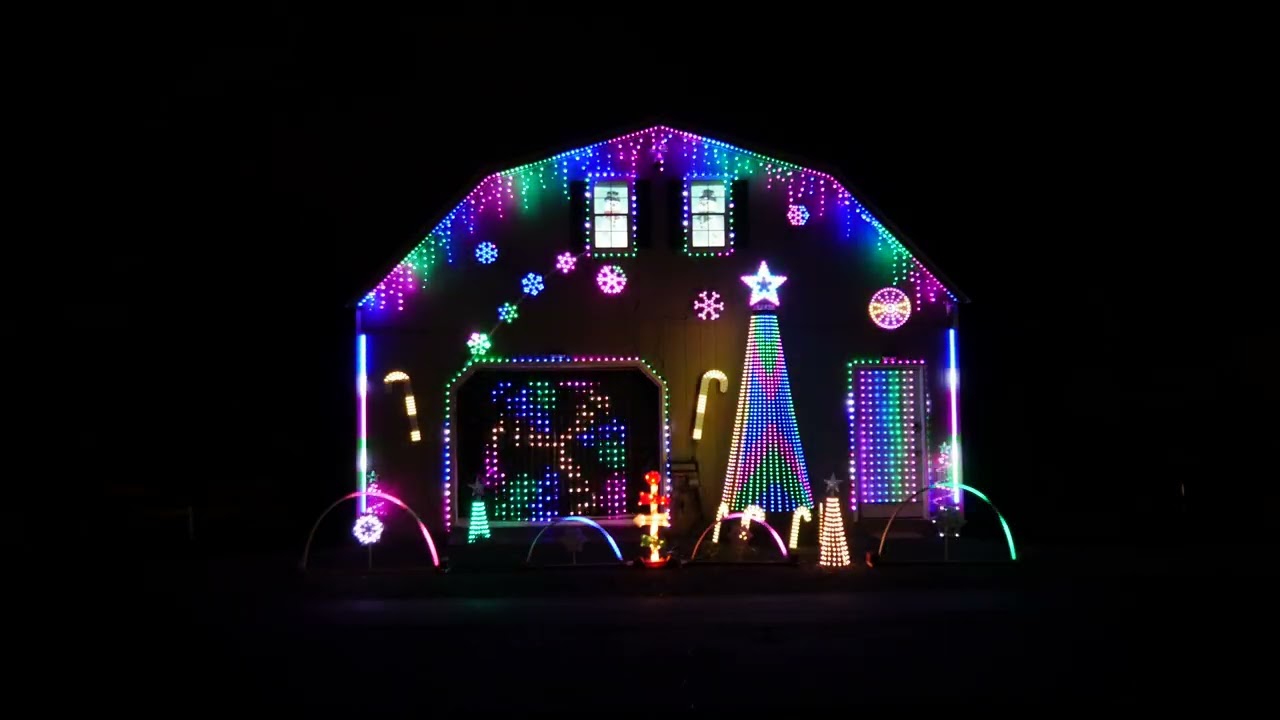
The garage matrix in this video is of the TCL brand running off wled/xlights
The garage matrix in the video below is the Avatar one using wled/xlights It looks better because there is black plastic behind it. The one above had a decretive Santa garage cover behind it, otherwise it would look better as the pixels are 3in spacing on the TCL vs 4in on the Avatar.
@MikeEitel Have you had a chance to try them with WLED yet (and if so do they work properly)?
There are many variants. Some work easily with WLED, some require setting up a custom layout (since there are 19 or 20 pixels skipped after each column), and only the first column works with WLED in others.
(Hence my above question about if Surplife ones work!)
Edit: src & to create a “custom layout” (not required for the curtain asked about @ the top of this thread) see Mapping - WLED Project
Describes a variant that works easily with WLED.
& the following comment is the most confirmation I’ve found as to how they are programmed:
I know from someone who has been to the factory that the process of programming the addresses of these LED involves shining light at the LED, using it as a photocell, to tell them which device is being programmed via commands over the wire. Don’t recall if they use a projector or a laser. I would expect the protocol is something along the lines of “If you can see light now, you are row x”, and similar for Y to program a large array quickly. It may be that higher than normal voltages are involved to do the write operation.
hello there ! to anwser i have found almost same curtain light in action store and… with a wled controller connected directly at start with his proper power supply come but i some how fried this and yeah they have under any plastic holder a tiny board with a LED probably ws thing model and it seem to be data passe throught this on scip this data and shift from any string in any shifter and cause to me a short somewhere and fried it….
I’m coming back with what seems to be bad news. After further investigation, it turns out the LEDs used in this setup are a mixed type. The “dumb” LEDs inside the holders are technically WS28xx‑based, and a logic analyzer confirms that the data line uses something similar to a WSxxxx protocol — but in a non‑standard way.
The issue is that the LED groups per segment are not individually addressable. They behave as grouped outputs, which explains the presence of small chips on each module: they act as signal shifters/drivers rather than true addressable controllers.
I found a video where someone managed to get them working with WLED, but in my case it didn’t work. I may have used too high a voltage or missed something, but so far it’s a failure. These modules can be used, but you should research them carefully first — the system is proprietary and seems to come from a Chinese manufacturer with no proper documentation.